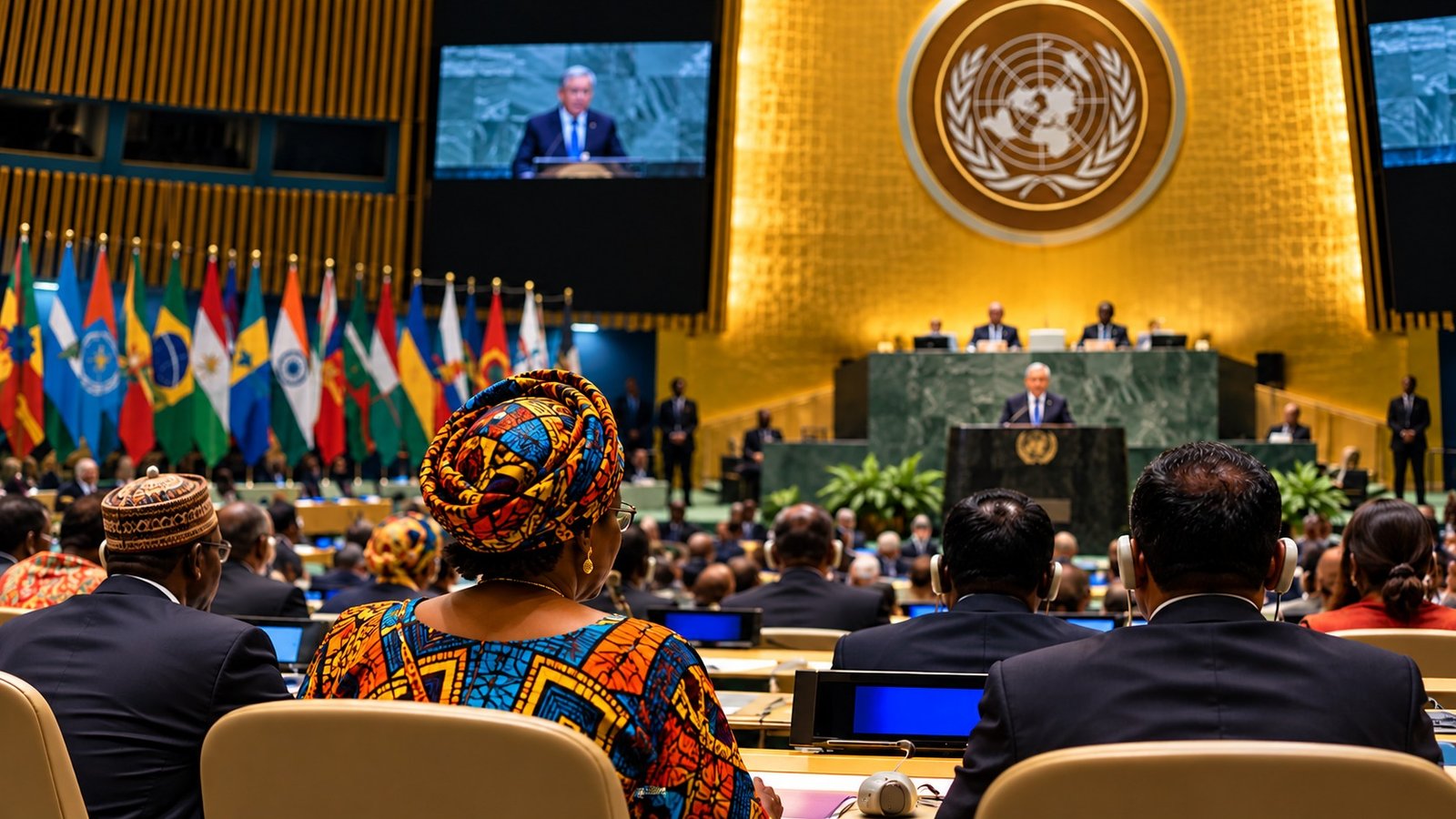
As leaders from around the world gather in New York for the 81st Session of the United Nations General Assembly, one issue has emerged repeatedly in discussions about the future of international cooperation: Who has a meaningful voice in shaping the decisions that affect the world?
For countries of the Global South, this question is particularly important.
Africa, Asia, Latin America, the Caribbean and the Pacific comprise most of the world's population and include many of its fastest-growing economies, youngest populations, critical natural resources and emerging centers of innovation. Yet many of the institutions that determine international rules on peace and security, finance, trade, technology and development were designed decades ago, when much of today's Global South had limited influence—or had not yet achieved independence.
At the opening of the 2026 General Debate, President of the UN General Assembly Khalilur Rahman directly addressed this imbalance, arguing that the Security Council must become more representative and highlighting Africa's continued underrepresentation. (United Nations)
For Global South International (GSI), strengthening Global South voices means more than securing opportunities to speak. It means ensuring developing countries have the representation, institutional capacity, evidence, partnerships and negotiating power necessary to help shape international decisions.
Representation must reflect today's world
The United Nations was established in 1945. The international system has changed enormously since then.
Dozens of countries that were colonies at the time are now independent states. Some have become major economies, regional powers and important contributors to international peace, trade, technology and development.
Yet the structure of some global institutions has changed much more slowly.
This was raised directly during the 2026 General Debate. Angola's intervention argued for deeper reform of the Security Council so that Africa, Latin America and Asia are adequately represented in permanent membership. It also connected representation to decision-making on peace, development finance, climate and artificial intelligence. (UN Transcripts)
The President of the General Assembly similarly described Africa's underrepresentation as an issue of fairness, justice and institutional credibility, emphasizing that Africa cannot indefinitely wait for greater representation. (United Nations)
The issue extends beyond the Security Council.
Representation matters wherever international decisions are made—within financial institutions, climate negotiations, global health organizations, trade bodies, technology-governance forums and development institutions.
A genuinely multilateral international system should reflect the countries and populations that it serves.
From being heard to shaping decisions
There is an important difference between having a voice and having influence.
A country may participate in an international meeting, deliver a statement and still have limited influence over the rules ultimately adopted.
Strengthening Global South voices therefore requires moving beyond symbolic participation toward meaningful involvement in agenda-setting, negotiation and decision-making.
This idea was expressed clearly by India's Prime Minister Narendra Modi at the September 2026 BRICS Summit. Discussing emerging fields such as artificial intelligence, cyberspace, biotechnology and critical technologies, he argued that Global South countries should move from being “rule-takers” to “rule-shapers.” He also proposed strengthening negotiation, legal and diplomatic capabilities among young policymakers from developing countries. (PM India)
That distinction is significant.
The rules being created today will influence tomorrow's economies.
Countries that participate in designing international frameworks for AI, climate finance, digital trade, intellectual property, taxation, health security and emerging technologies will have greater ability to ensure those frameworks reflect their development circumstances.
The Global South therefore needs not only seats at international tables, but also the technical capacity to negotiate effectively once seated there.
Africa's voice in global governance
Africa provides one of the clearest examples of the representation challenge.
The continent consists of 54 UN Member States, yet it has no permanent seat on the Security Council.
The General Assembly President made Africa's representation a prominent issue in his opening remarks, stating that the Security Council should better reflect contemporary geopolitical realities. (United Nations)
South African President Cyril Ramaphosa has similarly argued that international institutions need to reflect current realities and that developing economies require meaningful participation in global decision-making. Speaking shortly before UNGA at the 2026 BRICS Summit, he emphasized that the voices of Africa and the wider Global South should be fully reflected in shaping the international order. (South Africa Presidency)
These arguments are not simply about institutional status.
Decisions made internationally can directly affect an African farmer facing climate change, a government negotiating debt restructuring, a health ministry purchasing medicines, an entrepreneur seeking access to international markets or a country attempting to develop its natural resources.
Representation therefore has practical development consequences.
Development finance must be part of the conversation
Another prominent theme at this year's General Assembly has been the international financial system.
Developing countries frequently argue that their development ambitions are constrained by high borrowing costs, debt burdens and insufficient access to affordable long-term financing.
At the opening of the General Debate, the Assembly President pointed to stalled progress on the Sustainable Development Goals, falling official development assistance and debt pressures affecting developing economies. He called for greater development financing and reform of the international financial architecture. (United Nations)
Angola's General Debate intervention similarly connected Africa's representation with development finance, calling for affordable financing, debt relief, technology transfer and greater participation by international financial institutions. (UN Transcripts)
This demonstrates why strengthening Global South voices cannot be separated from economic governance.
Countries should have meaningful participation not only in conversations about how development should occur, but also in institutions determining how development is financed.
South-South cooperation is creating another platform for influence
Global South countries are also increasingly working directly with one another.
South-South cooperation is becoming an important mechanism for exchanging technology, expertise, investment and development solutions.
Speaking on the UN Day for South-South Cooperation earlier this month, the General Assembly President noted that countries of the South have become increasingly important trading partners, investors and contributors to global economic activity. He also highlighted innovations emerging from developing countries in digital public infrastructure, financial inclusion, climate-smart agriculture, renewable energy and disaster preparedness. (United Nations)
This changes the traditional narrative.
The Global South should not be understood only as a collection of countries requiring assistance.
Developing countries are also producers of knowledge, technology and solutions.
A successful agricultural innovation developed in Brazil may have lessons for African countries.
Digital public infrastructure developed in India can provide lessons elsewhere.
African mobile-finance innovations have influenced financial inclusion globally.
Asian manufacturing experience can inform industrialization strategies.
Small island developing states possess valuable knowledge about climate adaptation and disaster resilience.
South-South dialogue creates opportunities for these experiences to travel directly between countries facing comparable development challenges.
International dialogue must include local knowledge
Global South representation should also extend beyond national governments.
International development discussions benefit from the participation of universities, researchers, civil society, businesses, young people, women, community organizations and diaspora communities.
Policies developed thousands of miles away from the people they affect can overlook important realities.
A farmer understands challenges that may not appear in national agricultural statistics.
A nurse working in a rural health facility understands supply shortages differently from someone reviewing a national spreadsheet.
A small business owner may experience trade barriers differently from policymakers negotiating international agreements.
Young entrepreneurs understand emerging digital opportunities that established institutions may overlook.
Strengthening Global South voices therefore requires creating pathways through which local experience can inform national policy and national experience can inform international dialogue.
Young people must move from participation to leadership
This is particularly important for young people.
The Global South contains some of the world's youngest populations. Decisions being made today about climate change, technology, employment, debt and natural resources will shape their lives for decades.
The President of the General Assembly has emphasized that young people should progress beyond being consulted and become participants in designing policy, creating enterprises and implementing solutions. (United Nations)
For developing countries, investing in the next generation of diplomats, economists, researchers, entrepreneurs, scientists and public-policy professionals should therefore be considered an investment in international influence.
Negotiating power is ultimately built through knowledge and institutions.
Countries need professionals who understand international law, economics, climate negotiations, global health, technology, trade, finance and diplomacy—and who can translate national priorities into credible proposals at international forums.
Technology is creating a new arena of global governance
Some of the most consequential international rules of the next several decades have not yet been written.
Artificial intelligence, biotechnology, cybersecurity, digital trade, data governance and critical technologies are rapidly changing economies and societies.
This gives the Global South both a challenge and an opportunity.
If developing countries enter these discussions late, they risk inheriting rules designed largely around the priorities of others.
If they participate early and collectively, they can help shape systems that account for affordability, development, technology transfer, linguistic diversity, infrastructure constraints and equitable access.
The 2026 BRICS discussions explicitly identified AI, cyberspace, outer space, biotechnology and critical technologies as areas in which equal participation in rule-making is increasingly important. (PM India)
For GSI, this represents one of the most important emerging areas for Global South cooperation.
Dialogue should not become division
Strengthening the Global South should not mean creating another geopolitical divide.
International cooperation works best when different regions bring their perspectives to the same table.
President Ramaphosa described BRICS as potentially serving as a bridge across geopolitical divisions, emphasizing dialogue rather than confrontation and arguing for multilateralism that is more inclusive and effective. (South Africa Presidency)
Similarly, the UN's discussions on South-South cooperation recognize South-South and triangular cooperation as mechanisms that can complement broader international partnerships. (United Nations)
This distinction is important.
The objective should not be Global South versus Global North.
It should be an international system in which no region's experience, interests or development priorities are systematically marginalized.
A stronger Global South voice can therefore strengthen multilateralism rather than weaken it.
GSI's role: connecting voices, evidence and partnerships
For Global South International, strengthening Global South voices should be practical.
It means creating platforms where policymakers, researchers, communities, businesses, development organizations and diaspora professionals can exchange ideas and develop solutions.
It means supporting research that provides governments and institutions with evidence for international negotiations.
It means translating community experiences into policy discussions.
It means strengthening connections among countries facing similar development challenges.
And it means creating partnerships across the Global South—and between the Global South and the wider international community—that move beyond dialogue toward implementation.
GSI can contribute by focusing on:
Policy dialogue and research that brings Global South evidence into international debates;
South-South knowledge exchange connecting governments, institutions and professionals across regions;
Diaspora engagement, connecting expertise abroad with development priorities at home;
Youth leadership and professional development to strengthen the next generation of Global South policymakers and negotiators;
Government and institutional partnerships that translate international dialogue into practical programs;
International development diplomacy connecting development priorities with potential partners and financing; and
Community representation, ensuring international discussions remain connected to the people development policies are intended to serve.
From voice to agency
The central challenge is ultimately not whether the Global South can speak.
It already does.
The deeper question is whether its perspectives meaningfully shape international decisions.
The 2026 General Assembly discussions show that demands for more representative global governance remain prominent. The President of the General Assembly has placed Security Council reform, development finance and representation—particularly for Africa—within his agenda for rebuilding trust in multilateral institutions. (United Nations)
At the same time, South-South trade, investment, technology and cooperation demonstrate that developing countries increasingly possess resources and knowledge that can strengthen their collective influence. (United Nations)
The next stage must therefore move beyond representation toward agency.
Countries of the Global South should increasingly participate not only in implementing global decisions but in defining the problems, designing the solutions, negotiating the rules and evaluating the results.
For Global South International, strengthening these voices is ultimately about building a more inclusive form of international cooperation—one in which development experience from Lilongwe can inform discussions in New York, innovation from New Delhi can support communities elsewhere, African priorities can influence global institutions, and local communities can contribute to decisions that ultimately affect their futures.
The international system will be stronger when the Global South is not simply invited into the conversation but is fully involved in shaping it.
From representation to participation. From participation to influence. From influence to shared global leadership.
Global South International (GSI) Connecting Global South perspectives, partnerships and solutions to strengthen inclusive international dialogue and sustainable development.
This article reflects official UN General Assembly and government statements available through 28 September 2026, including the 81st Session of the UN General Assembly and related high-level discussions. (United Nations)