Across the world, communities are confronting challenges that increasingly overlap: climate change, food insecurity, rising debt, conflict, disease outbreaks, unemployment, inequality, displacement, water scarcity and rapidly changing technologies.
These pressures are particularly severe in many countries of the Global South, where communities often face the greatest exposure to shocks while having fewer financial and institutional resources with which to respond.
The discussions taking place during the 81st Session of the United Nations General Assembly (UNGA) in New York have reinforced an important message: development cannot simply be about responding to crises after they occur. It must be about building communities, institutions and economies capable of anticipating shocks, adapting to change and continuing to improve people's lives despite uncertainty.
The 2026 UN high-level agenda reflects this interconnected understanding of resilience. Alongside the General Debate, world leaders have addressed sustainable development, the right to development, climate action and just transition, sea-level rise, and pandemic prevention, preparedness and response.
For Global South International, this raises an important question: What does it actually take to build a resilient community?
The answer extends far beyond disaster preparedness. Resilience begins with sustainable development itself.
Resilience starts with people
A resilient community is not simply one that survives a disaster.
It is a community where families can access healthcare before an illness becomes an emergency; where children can attend functioning schools; where people have clean water and sanitation; where farmers can adapt to drought and changing rainfall; where young people can find productive opportunities; where women participate meaningfully in economic and community decisions; and where institutions can continue delivering essential services during periods of disruption.
This people-centered understanding of development featured prominently in the UN's commemoration of the 40th anniversary of the Declaration on the Right to Development.
UN General Assembly President Khalilur Rahman emphasized that development should not be delivered to people from above but shaped with them, with meaningful participation by women, young people, marginalized communities and those furthest behind.
Communities become stronger when people are not merely recipients of development programs but participants in designing, implementing and sustaining them.
Sustainable development is the foundation of resilience
The Sustainable Development Goals provide a useful framework because community resilience is inherently multidimensional.
Health cannot be separated from water. Water cannot be separated from climate. Food security cannot be separated from agriculture. Agriculture cannot be separated from infrastructure, markets and finance. Education affects employment, technology adoption and household income. Strong institutions influence whether resources ultimately reach communities.
Yet progress remains insufficient. According to the UN's 2026 SDG assessment, only 36% of the 139 targets with available trend data are on track or making moderate progress. Financing shortages, climate shocks, debt distress, conflict and inequality continue to slow implementation.
The challenge is therefore not a shortage of development goals. It is converting those commitments into practical improvements at community level.
Climate resilience must become community resilience
Climate change has been one of the clearest themes of this year's General Assembly.
For many communities, climate change is no longer an abstract environmental issue. It affects whether crops survive, whether families have drinking water, whether homes withstand floods, whether roads remain passable and whether livelihoods can continue.
Solutions discussed at the UN include resilient coastal infrastructure, restoration of mangroves, wetlands and reefs, risk-informed land-use planning, early-warning systems, social protection and locally led adaptation.
The same principle applies beyond coastal communities.
A drought-prone farming community may need water harvesting, irrigation, drought-resistant crops, agricultural insurance and better weather information.
An informal urban settlement may need drainage, sanitation, reliable electricity, safer housing and emergency preparedness.
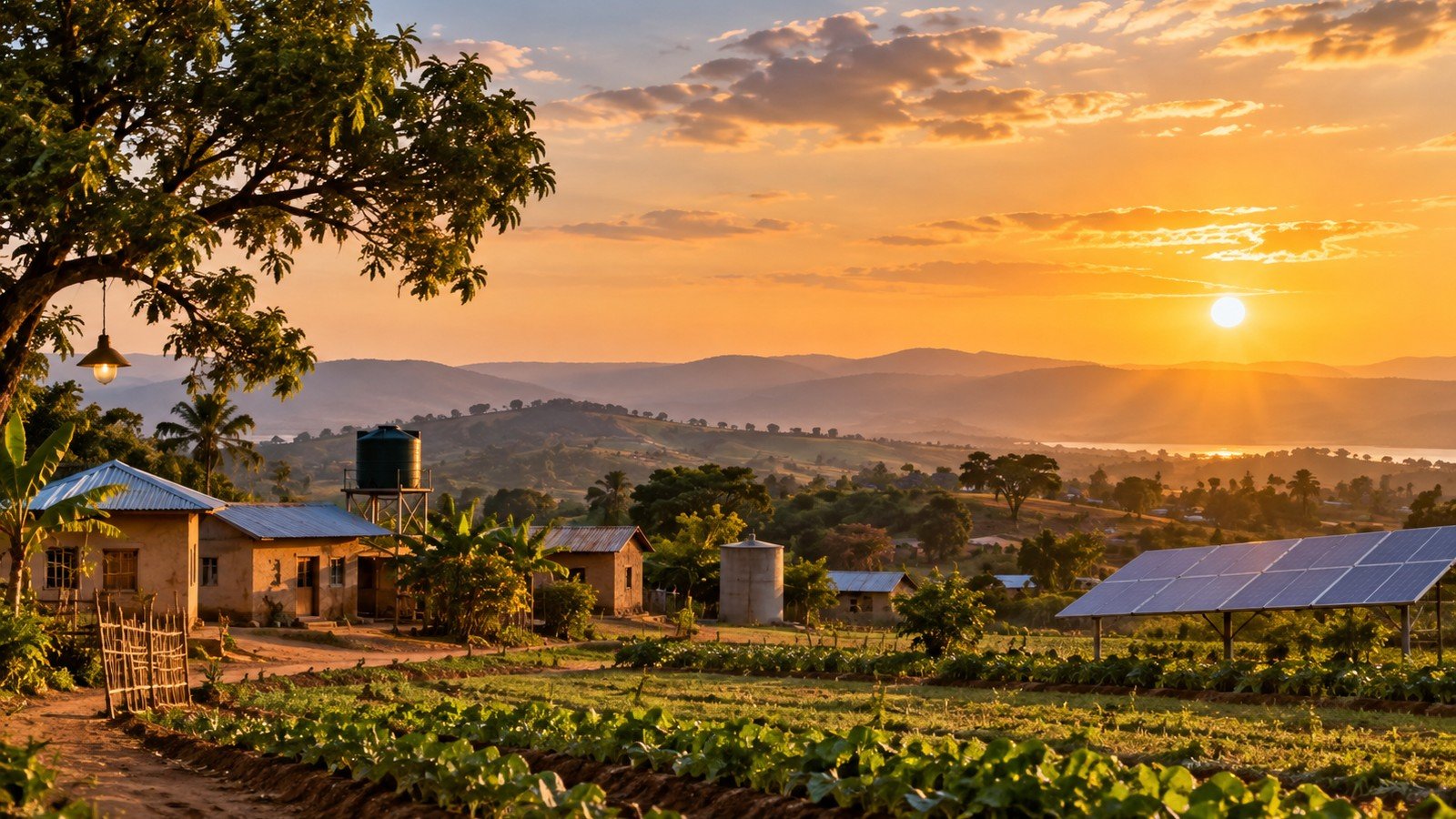
A remote village may need solar energy, clean water, basic healthcare, telecommunications and roads connecting farmers with markets.
Resilience must therefore be designed around the actual vulnerabilities of each community.
From the mountains to the sea: risks are connected
The interconnected nature of climate risk was also emphasized during the UN's 25 September meeting, “Sagarmatha to the Sea: A Call to Action for a Climate-Resilient Future.”
Changes in glaciers and mountain ecosystems do not remain in the mountains. They affect rivers, agriculture, drinking-water systems, hydropower, ecosystems and ultimately coastal communities.
This provides an important lesson for development organizations: interventions should not be designed in isolation.
Building a borehole without considering long-term groundwater availability is not resilience. Building a clinic without reliable electricity, water, medicines or trained health workers is not resilience. Building a road without considering future flooding is not resilience.
Sustainable development requires systems thinking.
Healthcare is essential community infrastructure
The COVID-19 pandemic demonstrated how quickly a health emergency can become an economic, educational and social crisis.
For communities, health resilience begins long before another pandemic arrives.
It means strengthening primary healthcare, ensuring access to essential medicines, improving maternal and child health, expanding vaccination, strengthening disease surveillance, supporting community health workers and ensuring that referral systems function.
It also means addressing affordability.
A medicine that exists but cannot be afforded is effectively inaccessible. A health facility located hours away may be inaccessible to a family without transportation. A national insurance system that does not reach informal or rural populations leaves important vulnerabilities unresolved.
This is why sustainable community development must connect healthcare access, affordability, prevention, health education and stronger health systems.
Water is development infrastructure
Few investments demonstrate the relationship between sustainability and resilience more clearly than water.
Reliable access to clean water influences health, education, agriculture, women's economic participation, nutrition and community stability.
For the Global South, investments in water should therefore extend beyond emergency water provision.
Communities need durable systems: boreholes where appropriate, rainwater harvesting, irrigation, watershed protection, sanitation, water-quality monitoring, maintenance systems and local capacity to manage infrastructure after development partners leave.
A project is not truly sustainable merely because infrastructure has been constructed. It becomes sustainable when the community can continue benefiting from it years later.
Economic resilience requires livelihoods
Communities cannot become resilient if households remain permanently economically vulnerable.
A family living on the edge of poverty can be pushed into crisis by one illness, failed harvest, flood or sudden increase in food prices.
Sustainable development must therefore help households build economic capacity through employment, entrepreneurship, agricultural productivity, skills development, financial inclusion and access to markets.
This is particularly important for women and young people.
Humanitarian assistance may help communities survive a crisis; sustainable livelihoods help them withstand the next one.
Both are necessary, but they serve different purposes.
Digital inclusion is becoming part of resilience
Technology is also changing what community resilience means.
Mobile banking can connect rural households to financial services. Telemedicine can connect remote communities with healthcare professionals. Digital learning can expand educational access. Satellite information can help farmers understand weather patterns. Digital identification can improve access to government services. Artificial intelligence may support disease surveillance, climate forecasting and agricultural planning.
But technological progress can also deepen inequality when infrastructure, skills and access are concentrated among already advantaged populations.
Digital development should consequently be viewed increasingly as community infrastructure, alongside roads, electricity and water.
Financing resilience before disaster strikes
Perhaps the greatest obstacle is financing.
Building resilient infrastructure requires resources today to prevent much larger losses tomorrow.
Yet many developing countries face high debt burdens and restricted fiscal space. These constraints reduce governments' ability to invest in people and sustainable development.
Why should communities repeatedly depend on expensive emergency responses when earlier investments in prevention, adaptation and resilient infrastructure could reduce future losses?
Development financing must increasingly support prevention rather than reconstruction alone.
Governments, development banks, philanthropic organizations, international institutions and private investors can help expand financing for climate-resilient infrastructure, health systems, renewable energy, water systems, sustainable agriculture and local enterprises.
But financing should also reach communities themselves.
Local knowledge matters
International development sometimes approaches communities primarily through what they lack.
Yet communities also possess knowledge, networks and coping mechanisms developed over generations.
Farmers understand local soils and rainfall patterns. Community health workers understand barriers preventing patients from accessing healthcare. Women's organizations often understand household vulnerabilities that national statistics cannot reveal. Traditional and community leaders can identify social dynamics that determine whether projects succeed or fail.
Resilience therefore requires combining scientific evidence, government policy, international expertise and local knowledge.
GSI's perspective: connecting the pieces
For Global South International, building resilient communities requires moving away from isolated interventions toward integrated development.
A community struggling with poverty may simultaneously face inadequate healthcare, unsafe water, weak transportation, unemployment, climate vulnerability and limited access to finance.
Addressing only one problem may produce temporary improvement without fundamentally changing vulnerability.
GSI therefore sees resilient community development as connecting several priorities:
- Healthcare access and stronger health systems, including affordable essential medicines and community-level care
- Clean water and sanitation, supported by sustainable infrastructure and local management
- Education and skills, particularly for young people
- Economic development and livelihoods, including entrepreneurship, agriculture and access to markets
- Climate adaptation and environmental sustainability, including disaster preparedness and resilient infrastructure
- Digital inclusion and data, allowing communities to access information, services and emerging technologies
- Partnerships and financing, bringing together governments, communities, businesses, universities, development institutions and the diaspora
- Community participation, ensuring development is undertaken with communities rather than simply delivered to them
These areas reinforce one another.
A healthier population is more economically productive. Better water reduces disease. Education expands employment opportunities. Reliable energy supports businesses and health facilities. Better roads connect farmers to markets. Digital connectivity expands access to information and services.
That is what systems-based development looks like.
From vulnerability to capability
One of the most important ideas emerging from the current UN discussions is that the international community must move beyond repeatedly managing crises.
For GSI, this distinction is fundamental.
Development should ultimately reduce the need for development assistance.
A successful water project should eventually be locally maintained.
A successful health program should strengthen the existing health system.
A successful agricultural intervention should increase farmers' ability to produce and earn independently.
A successful community enterprise should eventually generate its own revenue.
And a successful development partnership should leave behind knowledge, infrastructure, institutions and capabilities—not dependency.
Building resilience from the community upward
Global commitments matter. International agreements matter. Development financing matters.
But sustainable development ultimately succeeds or fails where people live.
It succeeds when a farmer can withstand the next drought.
When a mother can obtain medicine for her child.
When a community has safe drinking water.
When a young person can acquire skills and find productive work.
When a health facility remains operational during an emergency.
When communities receive warnings before disaster strikes.
And when local institutions possess the resources and capacity to solve problems themselves.
The theme of the 81st General Assembly—“Restoring trust, managing transformation: a United Nations that delivers for all”—is therefore particularly relevant to communities across the Global South.
For Global South International, sustainable development must follow the same principle.
The objective should not simply be to make vulnerable communities better able to survive adversity. It should be to help create communities with the health, knowledge, infrastructure, economic opportunity, environmental security and institutional capacity to shape their own futures.
That is the transition the Global South needs: from vulnerability to resilience, from assistance to capability, and from short-term interventions to sustainable development.
The 81st UN General Assembly General Debate is continuing through 28 September 2026. This article reflects UNGA speeches, high-level meetings and official materials available through 26 September 2026, rather than presenting a complete review of the session.